There’s a great deal of debate in the United States about whether climate change is a threat to life as we know it or hoax by some kind of fantastic scientific conspiracy.
Suggesting that all of these entities are working together to invent some kind of international fraud is a bit far fetched, but okay, say they’re all wrong.
In terms of solar hot water for major hot water consumers like hotels, apartment buildings, and laundry services, it doesn’t matter. Because while you may not care about climate change, you do care about saving lots of money.
For example, last week, we showed just one case study of how a medium sized California apartment building could save $16,000 a year by switching to a solar thermal system. (At a net cost of about $40,000 after all of incentives, the payback time is 3 years!)
Perhaps that’s hard to believe, but I’ve double checked these numbers with our Free Hot Water engineers, and they stand by those numbers for the given example.
My point is that as a landlord, hotel owner, or fitness center operator, you may have your doubts about global warming, but you at least have to believe in saving money.
Still skeptical about the benefits of solar water heating? Then please contact us. As we did in the case study, we’ll show you the numbers for your business and explain how we got those numbers. Worse case, you lose an hour and learn about solar hot water.
Then, even if you don’t believe in climate change, you can still help the planet by believing in going solar.
As some our regular readers know, Free Hot Water is part of a coalition of solar companies that are trying to get solar hot water back on the White House, as symbol of energy Independence. Sadly, as John Stewart brilliantly shows, President Obama is not the first president to suggest that America be energy independent by a certain date.
Some people think that it was only Jimmy Carter who attempted to get America off the oil addiction, but In fact, every president since Nixon has called for energy independence. That’s right. Nixon. Don’t believe me? Just watch:
Owners of California apartment buildings are one of the businesses that will benefit most from going with a solar hot water system.
Traditionally in California (and many states), apartment building landlords include hot water with every rental lease. Rather than individual hot water heaters, a central water heater (typically powered by gas) provides hot water to all residential units and onsite laundry facilities.
Consequently, with every bath, shower, dish washing, or load of laundry, the landlord is spending money to heat the hot water for the building’s residents. Installing a solar hot water system is a way to save 80% of that solar hot water cost.
Let’s take an example of an apartment or condo complex with about 120 units and 160 residents. While this is a real life example, please remember that every apartment building is unique with different requirements and water usage. For each unit the calculation is as follows: 20 gallons per person per-day for the first person, 15 gallons per-day for the second, and 10 gallons per-day for each person thereafter. Also included in the calculation are the 12 front-load energy saving washers to a total hot water consumption of 3,000 gal/day
So, even if you own another 160 resident building in California, your costs may be more or less than the following example.
Solar Hot Water Cost and Savings Example for a California Apartment Building with 160 Residents
Utility
PG&E
Min.Daily Demand @ 80% BTU
1,875,150
Est. Water Storage Requirements
3,000 Gallons
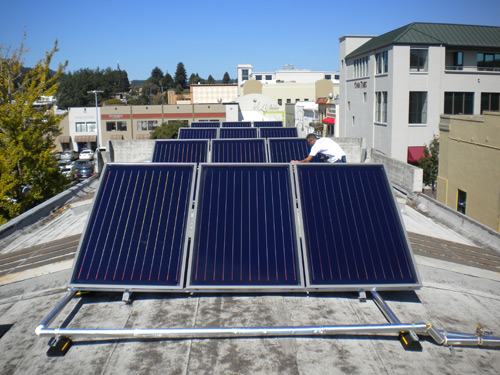
# of Free Hot Water 7000 collectors:
66 panels
Roof area required:
3,500 sq. ft
Est. gas bill for hot water before solar:
$16,000/year
Est. Cost before rebate, incl. engineering
$180,000
Estimated California Rebate:
$ -86,000
Estimated 30% Federal Tax Credit:
$ -54,000*
Estimated Net System Cost:
$40,000
Estimated Payback time:
About 3 yrs!
CO2 Saved from the environment over 25 years:
3 Metric Tons
* Marcs 5 yr accelerated depreciation may be available and is not included in the ROI calculations. Please consult with your tax attorney as for your eligibility.
Once again, it should be noted that every apartment building is different. The number of units, number of residents, type of washers, type of dish washers, hot water tanks, engineering, roof space and many other factors will affect individual costs.
Also, these figures are rounded and based on the expected PG&E rebate. However, as of August 2010, the rebate regulations are still being finalized by The California Public Utility Commissions (CPUC) may alter these numbers.
According to sources, the CPUC should finalize the regulations by some time in September. Consequently, now is the time to get your solar quote and start the design and engineering to get reserved on the first tier of California rebates. Rebate amounts will decrease as the number of installations rise, so early adopters will get the most generous part of the subsidies.
In addition to California, there are other states that have very generous rebates right now. Contact us at info@freehotwater.com to get the latest information of your state.
Finally, remember that there’s no cost to getting a customized quote for your apartment building or other business. Worse come to worse, you’ll spend a little time getting educated about solar hot water. Best case, you’ll save a lot of money going solar.
When designing a large scale system, we have to consider for microclimate and local radiation as well as water demand, pick hours and water consumption patterns.
Below is a standard report that Free Hot Water generates for each project, verifying the parameters and assumptions taken in the design process.
California residents not only have a reputation for being green, but they also have a reputation for staying fit.
Large health club chains have hundreds of locations, with members taking showers, soaking in hot tubs, and swimming laps in pools. Then there’s washing all of those towels. …every day. Of course, all of these activities have one thing in common: hot water. Lots of hot water.
The case for installing solar hot water at a fitness center is very simple:
The monthly water heating bill alone for a single California fitness center can be $4,000 a month–or more. The amount will vary with every location by its members, showers, pools, etc, but the utility cost will always be significant due to constant hot water needs.
Natural gas prices are only going to rise over the next few decades. Thus, whatever your cost is now, it’s only going to go up. If you plan to be in business at the same location for the next decade or two, read on.
Fitness centers are typically large warehouse-like buildings with flat roofs and minimal to no shading. Perfect for installing solar collectors on empty roofs that have no other use.
When a solar hot water system is sized and engineered correctly, 80% of a sports center’s annual gas water heating costs can be eliminated. No joke.
Consequently, after 5 years? 80% of the fitness center’s water heating costs are saved.
Did I mention the green PR benefits, saving tons of carbon emissions?
I know there are going to be skeptics out there since this blog post is written on a solar hot water site, but Free Hot Water is an engineering company first and foremost. We not only design our own solar collectors, but pride ourselves in being accurate with our designs and estimates.
If you own or manage a sports fitness center, all we can say is contact us and get a free estimate. We’ll show you all of the numbers and include all of the rebates and tax incentives. Then you can decide if it makes sense. In the worst case, you lose a few hours and get educated about solar hot water. In the best case, …you save a lot of money over the next 25 years and help the environment.
A former Pennsylvania Farm - Frack this. (Photo: Flickr/Arimoore)
There’s no doubt that if your heating water with electricity or oil, then installing solar hot water makes economic sense, especially with all of the state and federal incentives.
But there’s also a very good environmental reason for choosing solar over gas hot water, and it’s called Hydraulic Fracturing or “Fracking.”
“Fracking” is a new method developed by natural gas companies to pound out the natural gas buried in underground shale. The gas companies buy formerly pristine farm land in states like Pennsylvania and instead of planting crops, they pump a mysterious “fracking” fluid into the ground shale that frees the gas from the rocks.
The problem? Actually, there are several. For one, nobody knows what’s in this fracking fluid, since gas companies say that this fluid is “proprietary.” Meanwhile, the fracking fluid has been known to contaminate underground watershed, potentially poisoning the water supply of thousands of people.
As much as I’d love to be making this up, there are numerous reports about the dangers of fracking. Take the recent Vanity Fair article cites adjacent residents and farms having brown water flowing out of their pipes, staining laundry, scarring dishes and emitting a foul smell of chemicals.
The gas company in this article has been fined by the Pennsylvania Department of Environmental Protection, and the State has turned off water supply to residents, citing fracking contamination.
Now environmental groups are calling for the Federal EPA to more closely regulate fracking practices and, at the very least, to reveal what’s in that wonderfu, special, fracking fluid elixir. There is some question as to whether one company is using diesel fuel is in their fluid, which of course isn’t safe for drinking.
In addition to the water supply hazards, fracking is also water intensive—an issue for drought areas—and there’s no telling what damage is being done to the surface land due to fracking waste and clear cutting.
All this is to say is that there is an affordable and reliable alternative to fracking:Â Solar hot water is clean energy, requires few resources to manufacture, and is affordable now. Gas may be cheap now, but at what cost to our health and the environment?
Please consider solar hot water for your business and home. It’s a fracking-free alternative to potentially dangerous water heating.
We had a great time at Intersolar 2010 this year. Along with meeting our partners and installers at the show, Free Hot Water’s co-founder, Gal Moyal, was interviewed by Jennifer Runyon, managing editor of RenewableEnergyWorld.com.
If you haven’t seen it already, see how Gal talks about how Free Hot Water was founded and the rigorous process of getting solar collectors approved and rated by the SRCC.
Many times in this blog, we inform our readers about solar hot water subsidies and tax breaks. Well, some people comment to me that solar should stand on its own and shouldn’t be subsidized…except what about all of the oil and gas and coal subsidies?
And yet, a number of people say that solar shouldn’t have subsidies, and that the technology should stand on its own and that the government shouldn’t be supporting solar subsidies. My answer to that is this: fine.
That is, I understand the concern that tax payers shouldn’t subsidize a relatively new energy technology and that the market should determine price.
However, if you’re going to play that free market game, then it’s only fair that oil, coal, and gas companies play by the same rules, right? Therefore, oil, coal, and gas companies shouldn’t get subsidies either, and boy do they get subsidies.
FACT: From the New York Times: “According to the most recent study by the Congressional Budget Office, released in 2005, capital investments like oil field leases and drilling equipment are taxed at an effective rate of 9%, significantly lower than the overall rate of 25 % for businesses in general and lower than virtually any other industry.”
And with oil’s windfall, low-taxed profits since 2008, when oil prices sky rocketed, talk about a subsidy! But let’s dig further.
FACT: Also mentioned in the same article is the fact that the oil and gas industry spent $340 million on lobbyists since 2008, according to the nonpartisan Center for Responsive Politics, which monitors political spending.
FACT: According the Environmental Law Institute study, between 2002 and 2008, the coal and oil companies received $72 billion over the seven-year period, while subsidies for renewable fuels totaled only $29 billion. That’s 3.5 times as much. But we can dig even further…
FACT: President Obama’s 2011 fiscal year budget proposal sent to Congress calls for eliminating more than $2.7 billion in tax subsidies for oil, coal and gas industries. If passed, U.S. Tax payers will save (not give oil companies) 38.8 billion dollars.
I don’t get it. Why should we be subsidizing technologies that have been around for 100 years? Shouldn’t the oil and gas industry “stand on its own” and let the free market decide the winners and losers?
So, yeah, solar needs subsidies to encourage Americans to change their minds and break from the coal and oil status quo. But if you want to talk about solar’s high cost, then one wonders how much coal and oil would really cost without American tax payers subsidizing their dirty-air profits.
One last dig into coal and oil costs:
29 miners lives were lost in the Upper Big Branch Mine disaster in 2010.
Another 11 lives were lost in the BP oil explosion.
Thousands more lives have been lost in similar fossil fuel energy accidents in the last 100 years.
There has never been a single day in recorded history when so many lives were lost to solar technology in one day in a single event, and I doubt there ever will be.
If you’re a solar pro heading to Intersolar 2010 in San Francisco, we’d like to invite you to drop by our booth for discussions about Solar thermal collector technology and expanding the solar market in your area.
Whether you’re a solar techie, business person, engineer, or solar thermal veteran, you’ll be sure to have a great discussion our booth with Free Hot Water’s founders, Paul Burrowes and Gal Moyal.
Free Hot Water is still expanding and looking for more distributors throughout the U.S., so if you’re in the solar PV business, ask Paul or Gal about our solar thermal training program that will help you diversify your solar offers.
In addition, yours truly, Tor Valenza aka “Solar Fred,” marketing blogger for Renewable Energy World, will also be at the booth to discuss ways to get attention for your solar hot water business.
So please take some time to stop by our booth at the Moscone Convention Center on Level 1, Booth 7519, July 13th-15th for Intersolar 2010.
If you can’t make it, you can still have a discussion with Paul or Gal. Just give us a call.
It snows in Maryland and the entire Washington D.C. area, but that hasn’t stopped Maryland from supporting solar hot water for residences and businesses.
For those concerned about winters, know that solar engineers account for the cold months when designing your system. Certainly, your solar hot water system is not going to be as productive as the milder months, but the sun does shine in the winter and that thermal heat does provide a significant amount of hot water.
Also, keep in mind that whether you live in Maryland or Arizona, your hot water needs are almost always backed up by conventional water heating sources. So whether it’s winter or summer, your home or business will always have enough hot water for showers, washing clothes, etc. It’s only the proportion of solar heated water and gas or electric heated water that will change with the seasons.
Maryland provides many incentives for installing solar hot water for both residential and commercial applications:
Property Tax Credit. Most Maryland counties offer some kind property tax incentives. The amount and formula varies by county, so be sure to check this state incentive page under Maryland for details.
Solar Water Heating Grant. Maryland also provides a grant of 30% of the installed cost, up to a maximum of $2000. The grant is applicable to both residential and commercial solar hot water systems.
State Income Tax Incentives. The amount that you receive from the above grant is not considered income. Therefore, the above maximum $2000 grant is tax-free.
State Sales Tax Exemption. Unlike installing a conventional gas or electric water heating system, the solar installer will not charge you any additional sales tax, saving you even more money upfront.
Property Tax Improvement Exemption. Your Maryland property taxes will not go up from installing a solar hot water system as an improvement. In addition, if you install a solar thermal system for space heating or cooling, the assessed improvement value will be the same as a conventional system.
In addition to all of the above, don’t forget that the Federal government provides a 30% Federal tax credit. Also, these state incentives are just the beginning of your lifetime savings. As utility rates rise over time, you’ll save money with all of the free hot water you’re receiving. (Naturally, you’ll also be helping the environment. )
For more information to estimate your solar savings, costs, and return on investment, try our solar estimation tool or contact us for a customized free quote.
The Marines are marching to the beat of solar hot water. Listen to this NPR report for more details, but the gist is that the Camp Lejeune Marine Corps Base in North Carolina is putting solar hot water heaters on its on-base housing units.
These houses are generally rented to Marines with families, but the report says that the base will be using solar hot water for other base facilities as well, such as the hospital. The Marines don’t actually buy the solar panels, but instead are using a relatively rare solar hot water power purchase agreement (solar PPA).
Solar PPA arrangements are rare with solar hot water systems, but much more common with solar electric (PV) systems. With a PPA, the solar company installs the systems for little to no up front cost, but the panels are not owned or maintained by Camp Lejeune. Instead, the panels are owned by the installer. So how does the installer make money?
motely measure exactly how much solar hot water is being generated by the home’s solar panels. Then, similar to a utility, the home owner is charged a rate per therm of solar hot water generated.
To see a live example of a solar hot water monitoring system, check out our own Apollo1 monitoring system from Sun Reports. The data you see here is live and coming from the our 4000 series solar collectors that areinstalled on the roof of our San Jose headquarters.
Just like buying versus leasing a car, you’ll save more money over the long run when buying rather than PPA structures. That’s especially true with all of the rebates and incentive programs available right now.
For more information about innovative solar financing or any financial questions about solar hot water for your home or business, please contact us. At Free Hot Water, we sincerely want our customers to understand solar economics as well as solar technology.